Writing · December 31, 2025
Me and Nikon: 2025
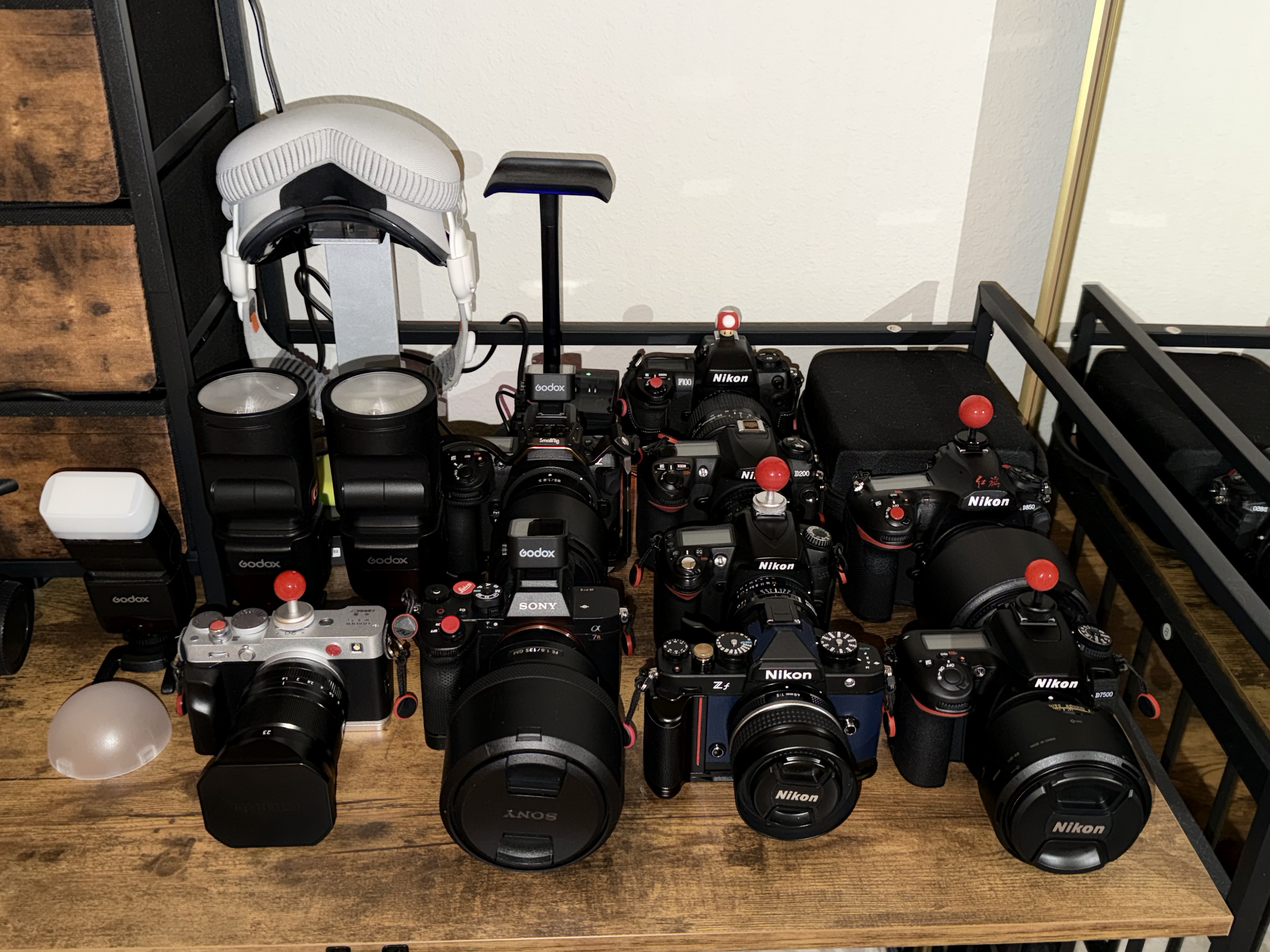
As the official "Me and Nikon 2025 Annual Summary" event kicks off, I figured it’s the perfect time to document how I, someone who just got into photography in 2025, ended up falling deeper and deeper into the Nikon rabbit hole.
Coincidentally, as a newcomer to the San Francisco Bay Area, following my car-less trek yesterday through San Jose and Menlo Park—visiting two camera shops and spending nearly 80 bucks (real dollars!) on Ubers in a fruitless search for a working EL4A battery—today, I received my final gift to myself for the year: a working battery for my Nikon D3. Sliding it into the D3 I acquired just before Christmas, hearing that crisp shutter sound, I expect tonight will be the last time this year I use a Nikon to seriously photograph my furry kids.
I want to use this article to record my journey through 2025, from getting to know Nikon through the Zfc to this D3 from 2008. The Nikon cameras that met me and helped me grow in 2025 include the Zfc, Zf, Z7II, D850, Z8, Z30, D200, D90, D7500, and D3. This is how I view photography, Nikon, gear, and life and the future.
First Encounter with Nikon
My first camera wasn't a Nikon; it was a Fujifilm. But the first camera I truly recognized wasn't a Fuji—it was a Nikon.
In the second half of 2024, I took a course at CMU called "Visual Computing System." At the time, I knew nothing about photography or imaging principles. I clearly remember the professor, in an attempt to explain basic concepts like sensor size and ISO, putting his "ugly, meaningless, and indescribable" photos taken with a Nikon D7100 on the slides, saying, "See, the camera explains it well, doesn't it?" Indeed, even as a total novice, I could hear how much he trusted and loved that Nikon D7100. When I checked the price of a D7100 on eBay back then and saw it was only a couple hundred dollars, I briefly considered getting into the hobby.
However, in March 2025, I went to Japan with a friend. My friend accidentally forgot their camera, and I had just received a tax refund, giving me the budget to buy one. Under my friend's influence, I initially bought an X100VI, mostly because the idea of buying a body and then having to buy lenses felt daunting for my wallet. I know people have mixed feelings about the X100VI, but price aside, it is a good camera—it made me realize for the first time that camera design has aesthetic value. Its retro style helped me understand the form from which cameras evolved. Later, in mid-March, I stood in a Best Buy in San Francisco, having an intense conversation with ChatGPT in front of the display case. I said I wanted a portable interchangeable-lens camera and asked what I should choose. GPT gave me a whole list: Canon RP, Sony 6700, Nikon Z5... To me then, those options were all foreign.
All I could do was stand at each counter and try the cameras that actually had charged batteries.
I have to criticize Canon here—at that moment, I could have easily gone the Canon route. Unfortunately, almost all the Canon floor models wouldn't turn on due to battery errors. The only ones I could try were entry-level models like the R100 and R50, which left me with a terrible impression of Canon for a long time (though that’s changed now). But when I stood before the Nikons—before I knew the memes about Nikon users being "honest folks," "landscape guys," or "birders who can't focus," and before I knew the "Nikon Anthem"—I just felt that through the EVF and the screen, it accurately reproduced the colors of the Best Buy counter, which were only slightly warmer than incandescent light. Compared to other cameras that were either overly stylized or deathly pale, my background in art made me sensitive to color, and I was immediately drawn to Nikon's "color." I told GPT, "This is it, it's Nikon. I like the colors." Later, I learned this was called white balance. Nikon truly has some of the best Auto White Balance among the Big Three.
So, having been brainwashed by Fuji into thinking "cameras should have lots of dials," my eyes locked onto the Zf and Zfc. Wanting a portable interchangeable-lens body, I walked away with the Zfc + 16-50 kit.
Nikon Zf
To be honest, the Zfc is truly beautiful. I once covered the brand name and asked several female friends which they preferred—this (Zfc) or that (X100VI)—and almost everyone chose the Zfc. It proved the Zfc has great potential. However, for a beginner who didn't know post-processing, didn't shoot RAW, and wasn't sensitive to exposure, the Zfc was the best teacher—because often, the Auto mode JPEGs didn't look that great. I tried downloading custom Picture Controls from nikonpc.com, but they all had a heavy "vintage" vibe, reminiscent of the strange color aesthetics found on old Chinese social media sites like Renren or Xici Hutong; frankly, they were unusable. There were plenty of filter settings shared on Xiaohongshu, but none were quite right. Relying on the Zfc's less-than-reliable filters forced me to exert more control over the output during the shoot. That’s when I began to understand why we need large aperture lenses, why people like low ISO, why some need tripods, and why some prefer the viewfinder. None of it is hard, and luckily I lived in Pittsburgh at the time, where there were many great views within walking distance. I learned a lot during that period.
I'm not entirely sure why I bought the Zf. When I saw Links' video introducing the Zf's dedicated B&W mode, I didn't think twice before ordering. By then, Nikon no longer felt foreign—I knew it was a full-frame Nikon, a beautiful full-frame, a brass-bodied full-frame. What reason was there not to choose it as an upgrade? Thus, the Zf became my primary camera for a long time.
NIKKOR Z MC 105mm f/2.8 VR S
Initially, I only had the Z 40mm F2 SE, the Zf's kit lens. On the first day I received the Zf, I took it out for street photography. Not five minutes from my door, I saw a young man waiting for a bus, holding some snacks to feed pigeons. A swarm of pigeons circled him, while nearby sat a couple of homeless people and others in tattered clothes waiting for the bus. I grabbed my camera to capture the scene but was limited by the 40mm focal length; I was too far away to get a clear composition. Back home, I realized the importance of longer focal lengths. Being new to the hobby, I didn't immediately buy the highly recommended 24-120mm F4 S, but instead got the 24-70mm F4 S. I loved it; in my early days with the Zf, it met most of my needs.
My first "S-Line" lens with a display window was the 105mm F2.8 S Macro. I didn't actually have much interest in product or insect photography, so to be honest, this lens gathered some dust later on. But in the early days, I used it to see the world reflected in my cat's pupils—I was amazed by that texture. It was a view I would never have observed closely without a macro lens. At the time, a friend had just bought the 70-180 F2.8 and told me he wanted to change his perspective to shoot things far away. I thought that while we were looking in opposite directions, we were both using Nikon glass to record things we couldn't see before. I also asked myself: as my cat reaches this age, how many years has it been since I looked into his eyes this closely?
I asked myself this repeatedly—before I picked up a camera, how many years had it been since I truly observed this world?
Z7II
The camera that truly brought me into the professional realm was the kind of design I initially looked down upon—the Nikon Z7II. During a Nikon USA refurbished sale, I was being tempted by high-resolution cameras, so I snagged a Z7II for $1399. At the time, I called it the tractor, meaning it wasn't as pretty as the Zf but it was a workhorse. It was then I realized my entry into cameras was different from most. Others start with modern bodies like the A7IV, Z5, or Z30 and are used to the PASM dial. I was more used to having ISO and shutter speed dials on top. I preferred the boxy retro look, so I initially thought the Z7II was "ugly." But that’s beside the point. Both the Zf and Zfc made me realize that the most special role of a camera for me isn't "creation."
To be honest, I never seriously studied how to take "good" photos. Perhaps my definition of "photography" differs from most. I don't care if my results are "eye candy," I don't care if they have deep meaning, and I don't care if a moment is "decisive." My entire understanding of photography aligns with what Roland Barthes said: "Photography is the art of resisting death." In this life, if I and everything around me had an infinite future, recording the present would be meaningless. Unfortunately, the universe is finite; what I see and remember is limited by time. The only thing that moves me is the ability to return to this moment in the future and see as much detail as possible. This is probably why I became a "gear head." I don't mind taking a thousand identical photos of my cat with the same lens, even if they are just moments of him sitting on his cat tree. They have no "meaning"—he isn't eating, grooming, or playing. Occasionally I catch a funny expression, but it's no big deal. I know my life isn't that exciting; my cat playing with something on the wall won't become a "significant" moment in my memory just because of that. That's why, to this day, I believe a high-resolution body and high-resolving lenses are vital for me.
I have a Vision Pro that mostly gathers dust, but the only reason I refuse to sell it is the sense of reality when returning to a moment. The experience on these devices is different. If you also believe your life is finite, that your life is worth recording, and that mundane moments are the most moving, then I believe the Z7II is an excellent choice. Years from now, 45 megapixels might be nothing, but I believe recording today's events with this level of clarity is something your future self will thank you for—I'll talk more about this later.
This Z7II helped me shoot many graduation photos for my classmates. Some even blamed the resolving power of the Z7II + 70-200 F2.8 S for making their carefully applied makeup look flawed—but most were simply amazed by the realistic details.
As a side note, once I tried overexposing a shot to create a high-key look to reflect the joy of two classmates, only to be told by a "photography expert" on Xiaohongshu that I "hadn't learned how to expose." Since then, I’ve stopped trying to do "artistic creation" in my photos. I don't take photos for money; I only please myself. My camera doesn't feel that pressure; it doesn't have to worry about its mechanical shutter being blown out by bursts of action. Most of the time, I shoot single frames. I also trust my Z7II implicitly; if it can be automated, I don't doubt it. It’s almost always Auto White Balance + A-mode, and its straight-out-of-camera colors and exposure have never let me down.
This Z7II accompanied me through graduation, trips to the California coast, wildlife watching, moon shots, and astrophotography. In terms of results, it successfully took over the mantle from the Zf and produced work I am very satisfied with. Of course, if I dumped these albums into a photography group, I’d probably be kicked out for posting "trash shots" every day.
A Ten-Year Reunion with Nikon
The subsequent gear swaps might not be as meaningful as the earlier ones. The Z8 replaced the Z7II entirely for its better autofocus, as I was shooting birds every day then. The Z30 was added because the Z8 was too heavy, and I needed a body for small lenses for lighter travel... Honestly, by this point in the Z series, I was in a "post-fever" state. What truly moved me again were the D-series bodies.
The Optical Viewfinder (OVF)—this magical thing made me realize that bokeh is "real," something you can see directly with your eyes rather than something that only exists on a sensor. It allowed me to complete the task of observation while shooting. In July 2025, I bought a brand new D850. Many thought it was unnecessary, but honestly, it’s one of the purchases I regret least this year. I had grown used to the "what you see is what you get" of the Z series EVF, but I had ignored what the world "actually" looks like when framing. Because of metering systems, an EVF struggles to truly replicate what the eye sees; often we need exposure bracketing to match our vision. With an EVF, you can't truly know the scene's actual exposure. While an OVF won't help you remember every exact color, at least you have an impression of the scene while shooting, and you can see the immediate difference between the viewfinder and the final image. This is why I prefer DSLRs.
I used the DSLR for a while, thinking I’d only buy one, since DSLRs are "relics of the past" and won't be updated anymore. There aren't many F-mount lenses left with usable quality. I thought my feelings for Nikon were deep enough—after using so many Z-mount lenses and bodies, if I wasn't a die-hard fan, I was at least a good customer.
Later, I brought a good friend into the photography world. He happened to inherit his father-in-law's Canon 7D. While I was lecturing him on how beautiful OVFs are and how the Canon 5D series once dominated the world, a spark of curiosity hit me. I wondered, in that era where Nikon and Canon were locked in fierce combat, which Nikon model rivaled the status of the 5D series? Gemini told me that if I wanted a Nikon body with enough commemorative value, I should look at the D700. But after a quick look at the D700's specs, I wasn't that interested. Gemini persisted: "What about the D200? CCD sensor, incredibly solid body, what do you say?" I checked and found I could snag a decent one on eBay for about $80. I’d never tried a CCD, so I figured I’d give it a go.
The D200 arrived quickly. For an $80 camera, I could ignore all its flaws—the 10MP resolution, the ancient screen, the fact it only takes CF cards... none of it mattered. My god, the build quality. I finally understood why everyone says Nikon is "military grade." Even though it went against my philosophy—even with my sharpest F-mount lens, the results weren't exactly "clear"—its unique shutter sound and the feel of the body made the results feel less important.
As if by fate, the night I received the D200, my hard drive finally filled up from a year of random shooting. While cleaning it out, I stumbled upon photos from my high school military training, taken by a photographer hired by the school. I remember when I first saw those photos, I thought, "Wow, these cameras are different. Everything is so clear and holds up to zooming in. But I hear cameras are expensive, something a student could never afford. Oh well, I'll just look at them and be grateful the school hired a pro." Honestly, I still feel that way. Looking at those photos now—the faces I remember as being so young, people I haven't seen in seven or eight years since graduation—seeing them so clearly on my screen, I am still grateful to the person who pressed the shutter. Then it hit me: since these are original files, the EXIF must show what camera was used. I looked—and there was that familiar name: D200.
I can't describe the excitement I felt.
I looked at the D200 on my desk, which I had treated as a toy. Its kin had captured these moving photos in August 2015. Just hours before, I was complaining that it was "past its prime." I couldn't imagine I once used "clear" and "holds up to zooming" to describe this old soldier, but at that moment, I understood the meaning of the hundreds of thousands of shutter clicks I made this year more deeply than ever.
In 2015, mainstream lens resolution was around 10MP; the 24.5MP D3X was the king of high quality. Today, the 45MP Z8 and Z9 aren't even the top of the pixel heap. Time truly marches on, but a record of this moment, even if it looks blurry in the future, will carry this emotion from today to then.
But did you know the D200 was released in 2005? If it weren't for a battle-hardened Nikon D200 that completed its mission over decades to reach me, I might never have realized this so profoundly—I began to realize that memory is the thing with resolution. 2005, 2015, 2025... sadly, I no longer know what my life was like in 2005. But in 2035, I should be able to see clearly what I was doing today.
I believe the Nikon in my hand will fulfill its mission. Even if they aren't in my hands in a few years, in ten, twenty, or even more years, they will fulfill the hopes their owners placed in them.
D3 and Z5
The last Nikon body I bought in 2025 was the D3. As a 2008 body, it too is a veteran approaching 20 years. I bought it from an elderly man in an American family. When he gave it to me, he said the battery might be dead since he hadn't used the camera in years. Sure enough, back home, charging the battery and putting it in the body yielded no response. ChatGPT told me lithium batteries don't last that long and most EL4A batteries on the market today are likely dead. Given the age and the fact that original EL4As are hard to find, I agreed. Unfortunately, it was Christmas, and I spent yesterday scouring every camera shop in the Bay Area, only to be told they were out of stock. Luckily, I had the foresight to order one on Amazon the day before, and it arrived today. Inserting the new battery, the D3 came back to life. I instinctively opened the image playback and was shocked to find an 8GB CF card still inside. It held over 360 photos. They seemed to be from a family trip the old man took many years ago. Honestly, if these were posted on Xiaohongshu or a photography group, people would say they lack "depth" or "meaning"—just snapshots.
I messaged the old man and asked if he wanted the photos, or if he’d forgotten the card was inside.
He replied:
Please discard them. Some already left.
I felt a mix of emotions. But it seems this camera had already performed its mission for its previous owner so well that even those 12 million pixels of mundane details were enough to make someone who finds it hard to look back feel moved.
Also at the end of the year, due to work and visa status, I might not be able to return home for many years. I entrusted a friend to take a Nikon Z5—which I had snagged at a bargain price from the Nikon USA refurbished store—along with my Z 50 1.8S and 24-70 f4 S back to my home in Nanjing. I am the first person in our family to truly use photography equipment; our last camera was a Sony point-and-shoot from 2008 with about 8 megapixels, which wasn't great. At home, I have a Bichon I’ve had since 2016, a Pomeranian since 2017, and more importantly, my 70-year-old grandparents. My grandmother passed away last year. I told my mom very seriously that while the Z5 isn't the most advanced camera, she must take as many photos of everyone as possible. They don't have to be "good"—just use A-mode and shoot wide open.
My mom sent me her "homework" after receiving the camera.
In the photos, my Pomeranian has the clearest portrait of his life. My grandmother used to complain to me that he’s getting old. He doesn't want to go out much; often he just sits down and wants to be carried or go home.
Ah, I think it’s been seven or eight years since I looked into his eyes like that. The last time I looked at him that way was in 2017, when I brought him home before leaving for the US.
In the 2017 sunlight, I brought him home and couldn't sleep; the light was suffocating. For eight years, the days have blurred into a chaotic mess, like a row of captured ghosts floating over dry grass. Today, he is nowhere near as lively as he was then.
I am very grateful to the friend who brought me into photography. Even if he indirectly caused me to spend all this money, I am grateful he made me realize the importance of keeping records.
I am very grateful to Nikon for teaching me how to take photos, for accompanying me in recording this world, and for being invisibly by my side during those small moments of my life, leaving behind the most beautiful scenery and memories.
I am very grateful to every one of my cameras, and to that Z5 carrying a heavy mission back home. Your reliability allows me to look back at the stories behind these photos, to understand the importance of memory, and to gradually evolve from a novice to a gear head, and finally back to photography itself.
I am very grateful for every one of my "trash shots"; you are my best weapons against my finite life. As the Nikon Anthem says:
Was never much, but we've made the most. Here, beneath my lungs, I feel your thumbs press into my skin again.