Artistic Anatomy · Part 1 of 5 · May 16, 2021
Artistic Anatomy #1 Torso Overview
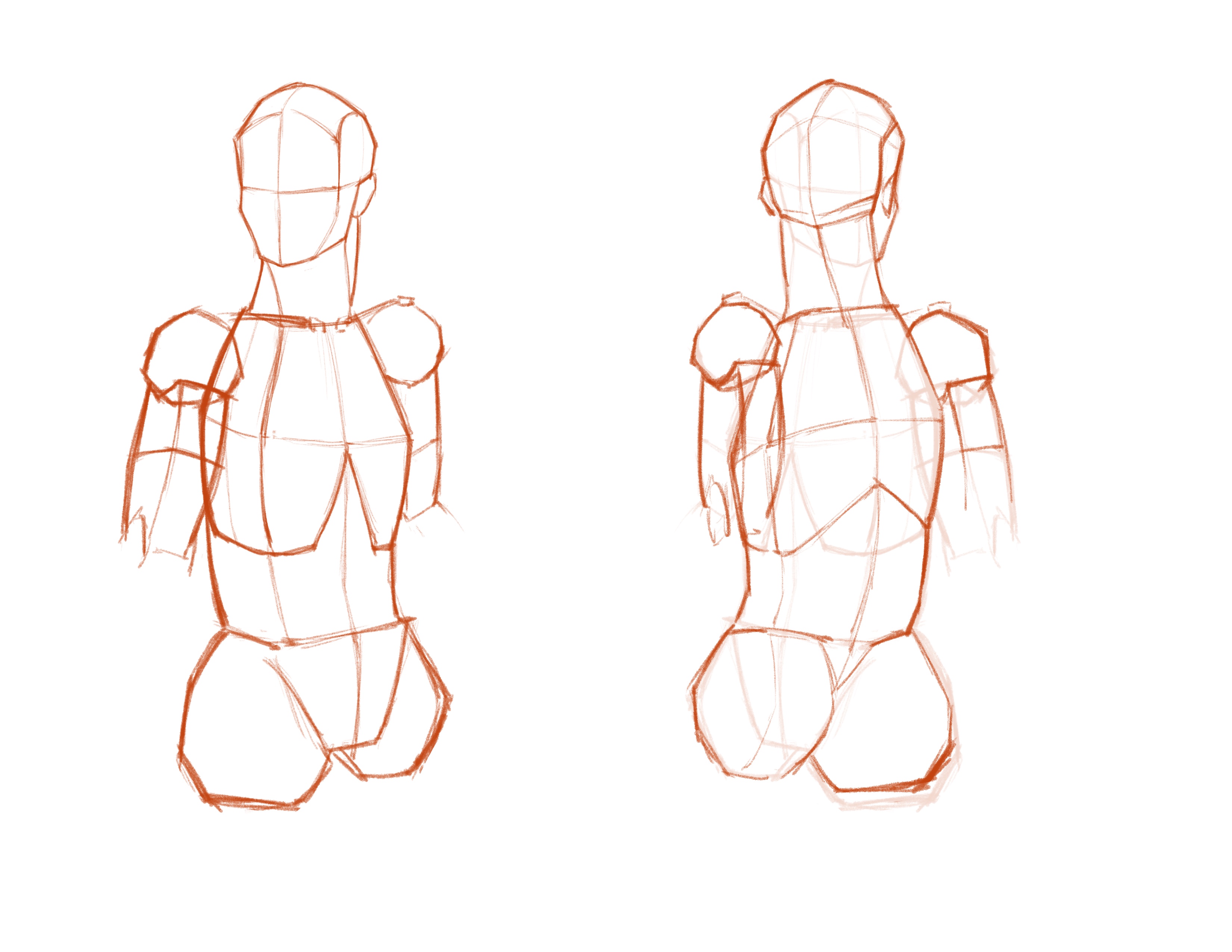
This note is mainly about the muscle interweaving and simple skeletal structure of the torso. English notes will be updated in the future. The reference books used are Human Anatomy for Artists (by Eliot Goldfinger, translated by Li Huijuan, first edition August 2018, published by Shanghai People's Fine Arts Publishing House) and Human Anatomy for Artists (published by Electronic Industry Press).
Since this article is only for artistic anatomy, it will not involve deep muscles that do not affect the external form. The muscle interweaving is mainly qualitative; please point out any errors.
Small Angle · Upper Body Simplified Forms
As mentioned in previous notes, we still simplify parts like the head, ribcage, pelvis, clavicle, buttocks, scapula, and shoulder ball. We use the following dynamics to observe the interweaving of upper body muscles. Start by drawing something like the following.
Sternocleidomastoid
First, we come to the head and neck. Although there are many complex muscles in the head and neck, not many directly and significantly affect the external form. Among them, the Sternocleidomastoid (Stm) is a very important muscle. The Sternocleidomastoid is divided into two parts: the clavicular head and the sternal head.
Sternocleidomastoid - Sternal Head (SC)
Origin: Mastoid process (can be understood as behind the ear)
Insertion: Sternum
Diagram:
Sternocleidomastoid - Clavicular Head (SS)
Insertion: Clavicle
From the outside, the sternal head is more prominent, especially when turning the head.
Trapezius
The Trapezius (Tr) is also a very important muscle in the head and neck. It is a large muscle that is very obvious from the outside.
Origin: Base of the skull, cervical vertebrae (note the position of the seventh cervical vertebra C7)
Insertion: Outer 1/3 of the clavicle, upper edge of the scapular spine, scapular spine tubercle (can be drawn at roughly 1/2 of the scapular spine), bottom of the ribcage
Rhomboids
The Rhomboids (Rh) can be divided into Rhomboid Major and Rhomboid Minor, but in reality, they can barely be separated, so treating them as one muscle is not a big problem. Additionally, the rhomboids can hardly be observed on the body surface; they are deep muscles. The rhomboids are not visible from the front.
Origin: Lower part of the nuchal ligament (basically can be drawn near the end of the cervical vertebrae—near C7) down to the fifth thoracic vertebra
Insertion: Medial border of the scapula
Diagram: The rhomboids are located beneath the trapezius. For clarity, the trapezius is shown with transparency here.
Infraspinatus
The Infraspinatus (In) is one of the back muscles. It is located below the scapular spine, hence the name.
Origin: Below the scapular spine
Insertion: Middle of the greater tubercle of the humerus (the large tubercle on the upper arm bone)
Diagram: The infraspinatus is also located beneath the trapezius. For clarity, the trapezius is shown with transparency here.
Teres Major and Minor
Teres Major (TMa) and Teres Minor (TMi) are muscles that link the scapula and the humerus. The infraspinatus and teres major sandwich the teres minor to form the entire infraspinatus structure of the back. Note that the teres minor and infraspinatus cover the same side of the greater tubercle of the humerus, while the teres major must wrap around the humerus and end at the biceps position. Therefore, the teres major and the teres minor/infraspinatus sandwich the humerus.
Teres Minor (TMi)
Origin: Roughly 1/2 of the lateral border of the scapula
Insertion: Lower side of the greater tubercle of the humerus
Only a small part of the teres minor is visible on the body surface.
Teres Major (TMa)
Origin: Inferior angle of the scapula
Insertion: Roughly at the position of the biceps on the humerus
Pectoralis Major
The Pectoralis Major (PMa) is a very prominent surface muscle located below the clavicle and above the ribs. Although the pectoralis major is a single muscle, its interweaving structure can be summarized into three parts: the clavicular part, the sternocostal part, and the abdominal part.
Clavicular Part
Origin: Lower edge of the clavicle (inner 1/2 part)
Insertion: Anterior side of the humerus
Sternocostal Part
Origin: Sternum
Insertion: Anterior side of the humerus, inserting above the clavicular part's insertion point from underneath
Abdominal Part
Origin: Ribs
Insertion: Anterior side of the humerus, inserting below the sternocostal part's insertion point from underneath
Deltoid
The Deltoid is the most prominent muscle in the shoulder area and is a muscle whose movement can be clearly seen on the body surface. The three bundles of the deltoid basically grow along the clavicle-acromion-scapular spine axis and terminate on the lateral side of the humerus. The anterior deltoid converges from the outer 1/3 of the clavicle to the lateral side of the humeral shaft; the middle deltoid grows from the acromion and converges to the lateral side of the humeral shaft; the posterior deltoid grows from the lateral side of the scapular spine and also converges to the lateral side of the humeral shaft.
Origin: Outer 1/3 of the clavicle, acromion, lower edge of the scapular spine
Insertion: Midpoint of the lateral side of the humeral shaft
Rectus Abdominis
The Rectus Abdominis (RA) is a prominent muscle on the surface of the abdomen. What people usually refer to as "eight-pack abs" are the four muscle segments on each side of the rectus abdominis. The lowest muscle segment is larger, and some people can distinguish two parts within this segment, but they are almost invisible on the body surface. The four muscle segments on both sides meet at the central Linea Alba, which is separated from the external oblique. The Linea Alba starts from below the sternum, reaches the pubis, and gradually disappears below the navel.
Serratus Anterior
The Serratus Anterior is located on both sides of the body. It is named "serratus" because it looks like saw teeth. It is usually more clearly observed in individuals with lower body fat. They are basically distributed along the ribs, originating from the upper 8-9 ribs, but due to muscle coverage, usually only the bottom 3-4 are visible on the body surface.
Origin: Distributed along the upper 8-9 ribs
Insertion: Vertebral border of the scapula
External Oblique
The External Oblique (EO) is adjacent to the serratus anterior, interweaving with it; it is adjacent to the rectus abdominis but does not interweave.
Origin: Lower 8 ribs
Insertion: Although anatomically the external oblique terminates at the Linea Alba, for drawing purposes, because it is obscured by the rectus abdominis, we can roughly understand it as terminating at the lateral side of the rectus abdominis.
Latissimus Dorsi
The Latissimus Dorsi (L) is the most prominent single muscle on the back. It is located below the trapezius, covers the back portion of the external oblique, and reveals the interweaving structure of the infraspinatus, teres minor, and teres major. The latissimus dorsi wraps from the back to the armpit, so in people with well-developed latissimus dorsi, part of its contour can be seen even from the front. This is especially obvious when raising the arms.